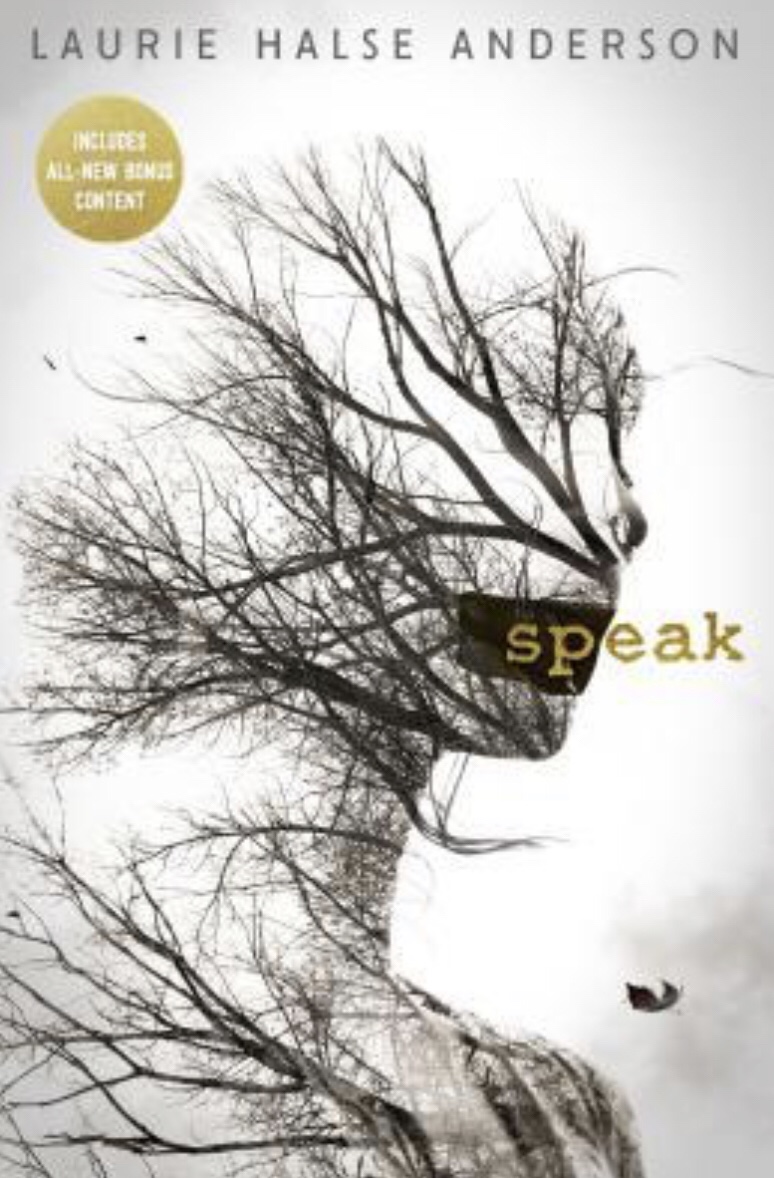
This young adult novel addresses the impact of sexual trauma and how one freshman student tries to navigate life after rape. This very real topic that has become a part of too many lives is brought to the forefront of the conversation as the main character Melinda Sordino struggles to find her place in her high school community after the event that changed everything.
This book was a new read for me and the topic and cover art intrigued me. Author Laurie Halse Anderson tackles the painful topic of sexual assault in this young adult novel. While this topic makes people uncomfortable – and silent, Anderson brings this conversation forward using the voice of the main character Melinda. As a female adult, I have experienced high school and all the typically teenage challenges that range from school culture, student groups or clans as named in Speak, and the emotional roller coaster of finding my own feet. Now imagine compounding all of those challenges with the addition of a life altering trauma. Narrated by Melinda, readers hear what this freshman is thinking as she moves forward returning to school with a new reputation and tainted perspective.

Melinda tries to become invisible in her high school and finds an outlet in the year long assigned art project to transform a tree into an object that makes a statement. Just as Melinda’s friend Ivy describes Melinda’s art as scary, the kind of scary you don’t want to look at for too long, Speak opens up a delicate topic by looking at the person behind the trauma. Melinda is more than a victim, and one event should not and does not define who she is.

There is power in the ability to speak your own truth. This book tackles a topic that too often is not spoken about. While describing the topic as sensitive, controversial, and delicate we still avoid calling it by name. Laurie Halse Anderson puts into words what so many cannot, or have struggled to verbalize.
As a teacher, I appreciate the value of this book and the story that unfolds from it’s pages. I can also admit that it would make me very uncomfortable using it in the classroom. Defensively I will say that I believe my students are too young, or that the topic is too mature. Honestly I know that students endure trauma of all sorts and it the very things that make common society uncomfortable need to be addressed in a way that allows our children to heal and move forward.
After reading Speak, I would suggest this selection for 8th grade classes and above. The content invites students and teachers to make connections to the text to extend personal and academic growth. This age group is preparing to enter the highly social realm of high school and all that that entails. They are aware of mature and sensitive topics, and they are still bold enough to speak up and speak their minds.
Ideas for Classroom Incorporation of Speak:
- ELA – symbolism, point-of-view, inferencing, expository writing, vocabulary, summarizing, visualization
- Social/Emotional – personal trauma, social interaction, school culture, behavior, reporting procedures, community resources
 Mrs. Kinnamore’s Bookshelf